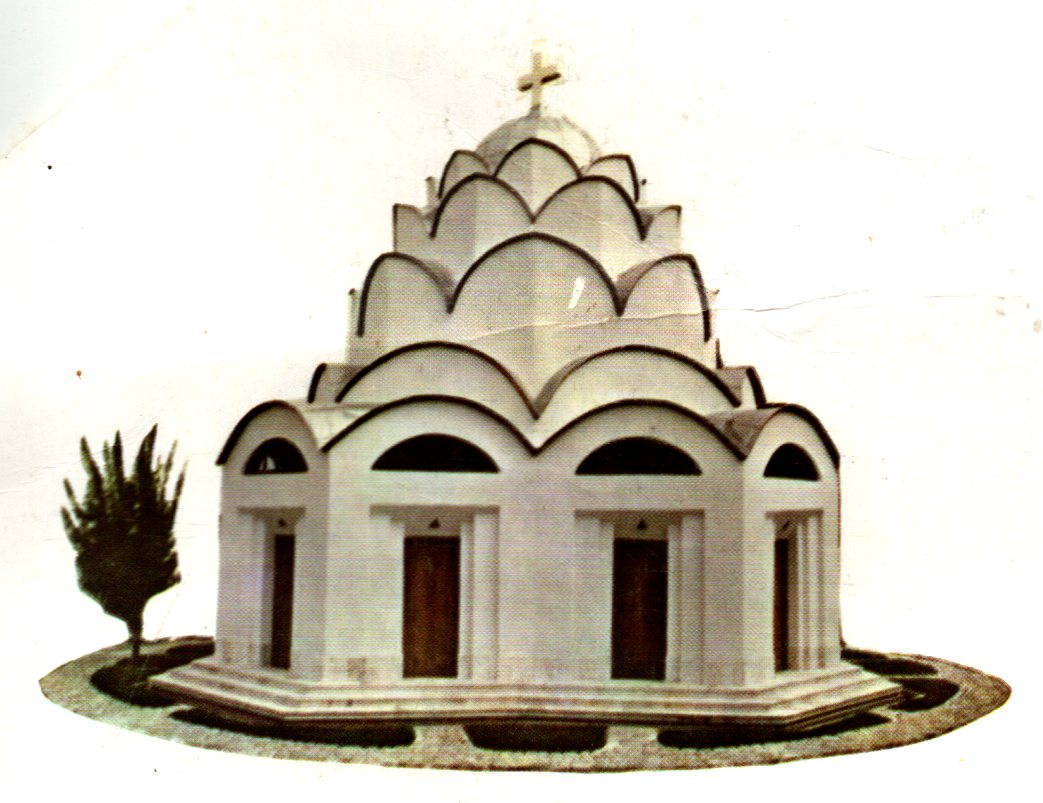
The catholicity of the New Jerusalem Church – a pneumatological dimension
Motto:
«The true church on the earth means sons of God, gathered together around the Lamb of God, Who is broken as food for the forgiveness of the sins, committed and forgiven by repentance.»
(Excerpt from the Word of God, from 07.01.1997 - O.S. / 20.01.1997. - N.S.)
From the unity of the Holy Spirit in the unity of peace, to the Catholic-synodal schism
The visible foundation of the Church at Pentecost (see Acts, chapter 2)meant the expression of the unity of the Holy Spirit of the first Christians as member of the body of Christ in its wholeness, as it was prefigured in the Eucharistic community of the Lord’s Supper.
Even from the beginning, these attributes of perfection in fulfilling and wholeness in covering for the church were expressed by the Greek term „katholiki“ (catholic). This term was, in its original meaning, very far from the „universal“, meaning, which is used today, denoting instead „eschatological unity of everyone in Christ“ in a real local church.
Subsequently, the conceptual transformation to the „catholicity“ in the sense of „universality“,had taken effect not only in the western church, growing to the ambition of a worldwide territorial and administrative expansion, but also in the Orthodox Church. In the Russian theology of the 19 th century the term „sobornost“, comes into being, deriving from „sobornaia“, a word that translates „catholicity“ into the Slavonic Creed. Unfortunately in both churches the initial significance of the „catholic“ or „synodal“,attribute, ascribed to each local church, had been darkened. From one eschatological reality, understood as the work and communion of the local church, which makes the body of Christ objective through Eucharist, it has been drifted in interpretation to the idea of division between local and universal. It has been installed into the world the betrayal of the catholic perspective (in which Christ was present wholly in each Eucharistic community) by the embracing of an exterior administrative structure required by force with an authority that had the inclination to absorb or even annihilate, by its universality, all the subordinate local churches. Once with the generalization of the metropolises in the church - based on the structures of old Roman provinces and then of the Byzantine one - and subsequently of the patriarchies, the center of gravity of the local church has moved to wider territories incorporating the dioceses of a province under the authority of one bishop, the metropolitan one. The metropolitan system represented a modality of circumstance in the localization of the church. Subsequently, the modern doctrine of the nation and of the independent state forced the generalization of another principle, the autocephalous one, which emphasized the theological confusion from the Orthodoxy, calling „local churches“ all the autocephalous churches. Thus it was created the possibility that the Episcopal dioceses to be absorbed and replaced either by a permanent synod, or by the bishop who is chosen „lifelong“ as the first standing one of the autocephalous church, without these really representing all the dioceses or parishes, which are and remain the authentic local churches of the territory which he theoretically controls it. That is why no metropolitan church, archdiocese or patriarchy can bear the proper title of a church, but it can only be called so by generalization, by the simple motive that it incorporates many local churches. These are the only organisms, which can be called churches, because of their nature, revealed and understood in Episcopal Eucharist, but also in the virtue of the apostolic exhortation of church founding in the cities: «I left you in Crete for this reason, that you would set in order the things that were lacking, and appoint elders in every city, as I directed you» (Titus 1/5). However, were the churches established by the saint apostle Titus really independent? The principle of the autocephaly extended to the level of a diocese is officially instituted in the church history only on the 3 rd Ecumenical Synod (431), and only as a riposte, as an imperious local necessity of the diocese from Cyprus to counteract the greed of the bishop from Antioch, who was aspiring to extend his jurisdiction upon the island of Cyprus as well. As a matter of fact, the calling to the judgment of the churches of the seven cities, led by their bishops (see Revelation, chapter 2), is illustrative, and symbolically at the same time. The number seven symbolizes the fullness of the judicial act, and the responsibility of the judged is preeminently local. The nationalistic and territorial ambitions had theoretically conferred increased responsibilities to the ruler of the autocephalous church, to the same extent in which they were dramatically diminished on the practical level. The scandalously uncanonical institution of the vicar bishop was generalized by a forbidden easiness, in satisfying of the taste to copy some innovations of the western church. It is an additional motive for the churches, which consider themselves „universal“ to review all the conceptions that promote the idea of derived ministry and to accept that the Eucharistic structure of the Church has priority over the institutional ones: in the Holy Communion, each local Church reveals the entire Church, the whole Christ, passing from the position of institution to the one of the „way of being“, as an earnest of the eternal life.
«Do this in memory of Me» (Luke 22/19)
The way in which the first church approached this problem is really the only one that is correct. At the Lord’s Supper, spent together with His disciples, the Savior, Christ, was not only making a prophecy concerning His memorial over the ages, but also a living illustration of His Kingdom. The old church has regained in the holy Eucharist the true image and structure of the Kingdom of the heavens (see Acts 2/42, 1 Cor. 10/16-17), in which God’s people consists of one Church. The ministry of the Church, in various manners, reflects and fulfills Christ’s own ministry, becoming a living projection of Christ’s presence into the world: «… and behold, I am with you always, even to the end of the age. Amen» (Matthew 28/20), and Christ has been but always by His presence and by the work of the Holy Spirit.
The Holy Spirit works wherever, however and whenever He wants («The wind blows where it wants to, and you hear its sound, but don’t know where it comes from and where it is going. So is everyone who is born of the Spirit.» - (John, 3/8)), And wherever He is present, the Christians are called to come into communion with each other and with Christ at the same time, in a churchly manner, continuing steadfastly in the apostles’ teaching and fellowship, in the breaking of the bread and prayer: «And they continued steadfastly in the apostles’ teaching and fellowship, in the breaking of the bread and prayer» (Acts 2/42). The external world is not ignorant as well, but it is invited to repentance, to baptism and to the receiving of the gift of the Holy Spirit: «…be baptized, everyone of you, in the name of Jesus Christ for the forgiveness of sins, and you will receive the gift of the Holy Spirit» (Acts 2/38).
The ministry in the church, therefore, becomes a gift of the Holy Spirit, Who proceeds from the God Father. This gift is essentially relating to promises prepared by the God of His creation for the last days:: «It will happen afterward, that I will pour our My Spirit on all flesh; and your sons and your daughters will prophesy. Your old men will dream dreams, and your young men will see visions. And also on the servants and on the handmaids in those days, I will pour out My Spirit» (Joel 3/28-29). As „the mission“ involves the apostolic sending and work to all the nations, „eshata“ involves the calling of the nations evangelized into one single people, of those who are worthy to be called God’s sons (See John 1/12), and to meet Him on His second coming (See 1 Thess. 4/17).
The Saint Ignatius of Antioch perceives the apostolic and synodal permanence in a conception of continuity, based not only on the apostolic succession from man to man, which is implicit, but also on the systematic assembly of the whole Church in one place of judgment; therefore, in a close connection with the Eucharistic community (See Saint Ignatius, Magn. 6,1). In this case, the apostolic succession is consecutive to the continuity of churches and is harmonized with the teaching of the Holy Scriptures, which calls the Church to systematically consume the Eucharist Supper in the same place, the place where eternal life is imparted from the Kingdom of God (see Revelation, 4/5).
Therefore, it is about one single Church invited to supper, in a prepared wedding hall. As a matter of fact, it cannot subsist in the world but one single true Church. Any other alternative demonstration is obligatory based on a sophism. However, the idea of uniqueness of the Church does not confer it this right to be constituted into one pyramidal structure and to be placed above the local churches. On the contrary, any ministering structure or work of the universal churchly community has to start from one foundation, which is the local Church. It is what God imposes through His Holy Spirit, Who introduces the realities of eschaton in history: «And also on the servants and on the handmaids in those days, I will pour out My Spirit» (Joel 2/29; Acts 2/17- 21). Thus, the Holy Spirit works in the last days not by the visible head of the Church, or by its administrative and synodal structures, but by its most humble and cleaner servants, of which many – to emphasize that they are not even part of the clergy – will be female.
We are contemporaneous with these exceptional events.
A people of sons, a remnant: the daughter of Zion.
On the day of Passover of the year 1955, the Holy Spirit released the spiritual springs of the heaven, releasing God’s word to be poured out abundantly for the washing of the eyes and ears of those who were following to come together in a spirit of Church and to born again: «Peace to you! Christ is risen! Christ is risen! Christ is risen! I am the Lord, Jesus Christ. I am not in a body, but I am in Spirit. I have come down on earth in My Spirit to gather a people together and to speak to it the mysteries for this time. I am the Word of God and I have come to speak on earth, and to prepare the way of My second coming, as it is written into My Book» (Excerpt from the Word of God, 17.04.1995. – O.S. / 30.04.1995. – N.S.);
«Do not doubt of My voice and do believe into My word through this helpless mouth, for I want to give you birth again, of the Spirit, […] to raise a new people for Me, a new Israel into the Romanian people, for the people chosen by Me in the past has completely gone bad» (Excerpt from the Word of God, 01.06.1955 – O.S. / 14.04.1955 – N.S.)
What motivates this supernatural intervention? Nothing else but the visible inefficiency of those almost two thousand years of preaching of the world churches to the world, interval in which the world has been degraded exponentially, until «it has completely become corrupted». That is why God, in His great love for the people, personally comes to repair now what the man „has completely spoiled“.
When the Son of Man comes, will He find faith on the earth?
The fact that God decided after such a long time to choose a people of sons, a remnant, that He may proclaim it the daughter of Zion, suggests two complementary hypotheses:
- The traditional churches with claims of universality (the „Catholic“ one and the „synodal“) one) have exhausted their chapter of credit, and God’s long endurance towards their implacable decline has come to an end.
The Catholic Church has squandered away its energy in the territorial conquest. Having practiced an aggressive missionarism, it has fulfilled the word of the Scriptures in letter but not necessarily in Spirit: «Go and make disciples of all nations […]» (Matt. 28/19).. In fact and in substance, the nations evangelized by it have remained equally unfaithful and careless to their salvation as before, engaging themselves into a visibly annoying dichotomy:
– a secular world engaged within a fierce struggle to get wealthy;
– a caste of the clerics who have extended over the ages a feeble struggle in preaching Christ efficiently.
The Orthodox Church, a little bit more pragmatic, or perhaps more comfortable, has not got tired to practice the missionarism at any price, pretending that it puts its own house in order, but the so called convenience has soon proved to actually be a state of self-complacency, which suggested its right to put on a gloss of empty glory from top to bottom. The effect was similar: once with the passing of the ages, the faith has grown cold and diminished in formalism, glamour and conservatism, two worlds detaching from her, which have developed in parallel:
– the vulgus, to a formal Orthodoxy, almost atheist, destitute of any authentic spiritual living, being satisfied to cross the threshold of the church „once in a while“,or perhaps at the main events of life (baptism, marriage or burial);
– the church institution, against the blatant glamour, basilical, scornful, but deprived of any charismatic efficiency, often proving unprincipled obedience to the atheist authorities and to the political police and even collaborationism, arrogant and irresponsible with these.
With some punctual exceptions of whose merits go to the local saints, the churches have gradually been deprived of charismata and have not known the living assistance of the Holy Spirit, Who works in a supernatural manner that is, He is not separated from miracles. In this manner, of a painful actuality, the thinking of the Scripture has become: «When the Son of Man comes will He really find faith on the earth?» (Luke 18/8).
The servants of the churches have felt attracted by the „joys of life“and gradually they have come to catch up with them little by little from the world, proclaiming them „the man’s rights“. It is known, for example, the debate among the western clerics concerning the renunciation to the „yoke“ of celibacy. Thus renouncing the idea of bodily cleanness, they are very close to generalize the mixture of the churches with the world, forgetting the warning of the Holy Scripture: «Friendship with the world is enmity to God» (James 4/4). In this way, the Churches head inexorably for secularization, putting off its power and formal right to spiritually control the Christians. These, in their turn, take advantage in justifying their actions, including their stealthily turning back and without any remorse to paganism. Shallow „official“ resistance of the churches is regarded with amusement by the secular social structures, which blatantly push the people towards an immoral living, impregnated with a gross materialism, which completely separates man from God.
- The time has come short (see 1 Cor. 7/29) and the day of the Lord has come near (see 2 Thess. 2/3), for the denial of faith has come true and «God’s adversary, the man, who had been hiding under a church robe and clothed with empty glory, setting himself up as God» (Excerpt from the Word of God, from 06.08.1997. – O.S. / 19.08.1997. – O.S.), «was brought into the open» (2 Thess. 2/4).
«Behold! The bridegroom is coming! Come out to meet Him!» (Matt. 25/6)
The calling, which God has been doing tirelessly from 1955 on, is the fulfilling of the parable of the virgins (see Matt. 25/1-13). The ten virgins are the Churches. Therefore, it is about the local churches, Eucharistic, and not about the two church institutes, each one of them considering to be „universal“, even though one calls itself „Catholic“, and the other „synodal“, with the desire to hide under the word, so that their nakedness and their weirdness of pomposity may not be brought into the open. Thus, the local churches are the virgins (those who managed to hold on to their virgin, apostolic purity) and have the candles in their hands (those who keep unspoiled the treasure of faith entrusted by the apostles). The fact that the parable divides them into wise and unwise virgins shows us the impartiality of the One Who calls them: He offers them all equal chances with the condition that in the time of calling, the one who is received to have the wedding garment, the oil burning in the candle and the fruit of the entrusted talents. However, can the churches of today come to meet Him as the wise virgins did, as Christ’s brides? The parable is challenging. It suggests that at least half of the local churches could have got the spirit of discretion and the zeal of preparation. Unfortunately, the oil has been poured out in time and out of the vessels of those who had prepared once. The parable is equally prophetic. If all the girls fell asleep, then this is the state of things in which all the churches were found upon the calling: «Behold! The Bridegroom is coming! ...» (Matt. 25/6).
One single local church – the Romanian one, born Christian and grown through martyr sacrifices – was somewhat complying with. However, she had to be woken up, shaken, washed, combed out, brushed and adorned, and then undressed of her unfitted garment of the red times in which she had fell asleep and then dressed in the whiteness of righteousness: «Oh, country, country! The red time had got into you and you had not known its face. You had not known that red is the chlamys of shame. Have you forgotten what it happened to Me under the cover of the red chlamys? The time of Edom had come upon you» (Excerpt from the Word of God, from 08.11.1995. - O.S. / 21.11.1995. - N.S.).
However, the church does not wake up but it rather stays in lethargy: «Your priests serve the pleasures and their spirit and name and they have no power to impart resurrection over you» (Excerpt from the Word of God, from 08.11.1995. - O.S. / 21.11.1995. - N.S.). Then God makes His word come down over Romania and reveals the mystery for it is the country of brightness (see Daniel 11/41-45), prophesying again and strengthening the prophecy made for it from eternity: «It will be that this chosen people will come to life little by little» (Excerpt from the Word of God, from 04.01.1992. - O.S. / 17.01.1992. - N.S.).
How did the churchly institution of Romania, once woken up from its sleep, respond? Obviously having been troubled by the fact that its state of self-complacency and sweet lethargy were disturbed, it did not hurry to light its candle and to come out to meet the Bridegroom. Even more, it struck God’s hand and did not want to put on the white garment and thus to enter the glory of the New Jerusalem, prophesied in the Scriptures. Because it did not receive the renewal in the spirit, its „synodal character“ has lost the Spirit’s assistance, for the Spirit works wherever He wants and how He wants (John 3/8). Therefore, will the Synod of the Church be able to declaim «For it seemed good to the Holy Spirit and to us…» (Acts 15/28),, when it turned its back at the Spirit’s calling? For the Bridegroom has actually come with His calling, to this church. As «In the beginning was the Word» (John 1/1), the same in the end, the Word of God has come down on earth, fulfilling the commandment of the Scripture, which proves it to be the new name of Jesus Christ: «… and His name is called “The Word of God”» (Rev. 19/13).
For though your people, Israel, are like the sand of the sea, only a remnant of them will be saved (Is. 10/20)
The Lord has kept for Himself a faithful remnant to which He came down in counsel of word and which received Him with joy. In this counsel that joins the heaven with the earth it is the synodal character in Spirit of the Church of the New Jerusalem. «She is made ready like a bride adorned for her husband» (Rev. 21/2), for it lighted its lamp and had kept it burning from the moment of the calling of the daughter of its people, the holy Virginia, the sixth apocalyptic trumpet, an incarnated angel, who had brought a voice from heaven on earth: «And sixth angel sounded. And I heard a voice from the horns of the golden altar which is before God» (Revelation 9/13).
But the people from the world did not repent even when they heard that God spoke to them from heaven, but rather they became stiff-necked: «And they did not repent of their murders or of their sexual immorality and nor of their thefts» (Rev. 9/21).
«Woe to you, scribes and Pharisees, hypocrites!» (Matt. 23/13-29)
The rejection of Christ, the Word, by the church institute from the world has had similar overtones with the rejection of Messiah by the scribes and Pharisees. The work of togetherness of the local churches from the world, which has brought the body of Christ as a sacrifice through Eucharist, has gone dark by the quenching of the Holy Spirit and by the despising of the prophecies, despite the warning made by the Saint apostle Paul: «Don’t quench the Spirit. Don’t despise prophecies» (1 Thess. 5/19-20). The church of the world loses its universal character choosing between God and the world to remain alone with the world and tragically forgetting that ministering in a church is a gift of the Holy Spirit.
Referring to the Pharisees and scribes, who speak in an academic language, but totally lost their faith and keeping silent tacitly when the word of God brings their shameful works into the open, the Saint Theodore, the Studite, says: «Then when the Ark is in danger, the Lord’s commandment is not to keep silent. If it is about faith, no one has the right to say: „But who am I? Am I really a priest? I have nothing to do with these. Or, am I a ruler? This does not want to have any kind of interference either. Or, a poor man, who hardly is able to earn one’s living? […] I have no right or any interest in this matter“. If you keep silent and remain reckless, then the stones will cry out» (Epistle II, 81). Unfortunately, the priests of the official church, in case they do not preach openly against God’s word and against the New Jerusalem, they keep a guilty and infamous silence, which they have learned well at the Faculty of Theology, as a typical strategy of „academic theology“: „No sword cuts off a bowed head“.
The Lord has chosen the poor to put to shame those that are strong
Because those who were invited, priests and bishops, did not come to supper (Luke 14/18-24), the New Jerusalem Church remains the only wise bride that shows the Bridegroom the light of her lamp: faith and love, obedience and submission. As a remnant, chosen by grace, she stays in the bathroom of her birth from above and does not go dry from the flowing of the spring of word. She gives birth to a people of saints, brothers in Christ, who have got caught up into the work of the word; they give themselves over to the work of disciples and apostles and spread the seed of the word over those who want to meet Christ. They live within a spirit of church, a true synodal church, in which it is not the man that works but the Holy Spirit, as He wills, giving to the Church of Christ the pneumatological dimension, which the worldly church has knowingly denied as many times as it has ignored the canons of the Holy Fathers, which should have remained steadfast, and, again, when it has ignored this word of God. They faithfully sit at the Lord’s word table and clothe themselves with this word and with the Holy Spirit, and they will receive the reward of disciples. They become a living parable for every Romanian people, for every Christian people, in such a way that he might turn back to God with his whole body, soul and spirit, and so that God may call him New Israel and to sanctify him, forgiving its wrongdoings, in such a way that the Son of God may visibly come down on earth, fulfilling the promises made over the ages: «Our Father Who are in heaven, make Israel holy and may Your name be hallowed in Israel by forgiving his trespasses, Father. Father, make a living kingdom from You over Your people and teach him to give himself over to Your will, to the will of Your word, Father, so that it may also be in Israel as in heavens, Father» (Excerpt from the Word of God, the speaking of the Lord’s mother, from 08.09.1996. - O.S. / 21.09.1996 - N.S.).
Priest Nicodim